
Technical Whitepaper
Enterprise Digital Transformation Playbook 2026
Process automation · AI analytics · GEO visibility — a practical three-pillar framework for 2026, built from GNS delivery experience across railway, government and enterprise.
- Process automation that cuts cost and cycle time
- AI analytics that predict instead of report
- GEO visibility in AI search answers
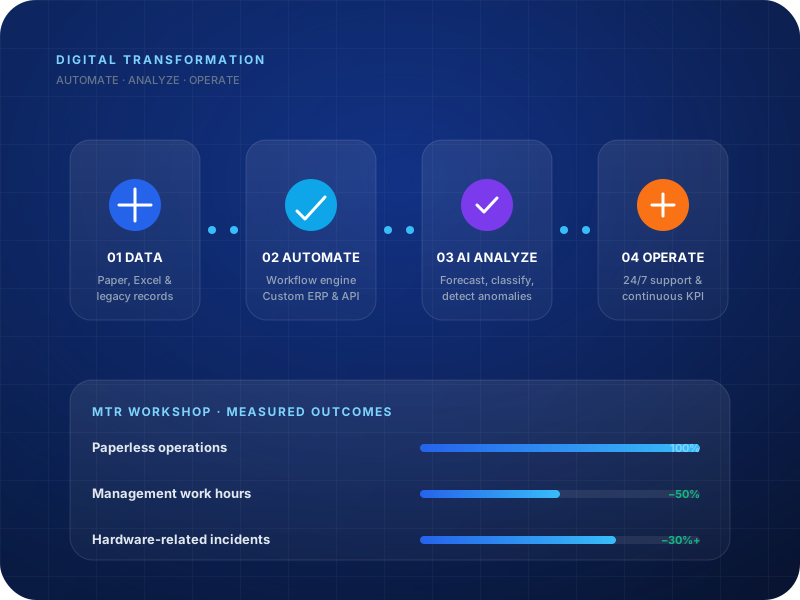
- MTR workshop: paperless in 3 years, −50% admin hours
- 100M+ train logs analysed daily
- Free GEO report at geo.gnshk.com
Technical Whitepaper: AI-Driven System Resilience
Executive summary
2026 is the year digital transformation stops being a slogan and becomes an operating system. Hong Kong businesses and government bodies face the same pressures: rising labour costs, thinner margins, ageing systems and a customer base that increasingly asks AI engines — not search bars — where to buy, who to trust and how to get things done.
This playbook is a practical, three-pillar framework for enterprise digital transformation in 2026, built from GNS Technology's delivery experience across railway, government and enterprise environments:
Pillar 1 — Process automation. Turn paper, spreadsheets and manual handoffs into automated workflows. Real examples: the MTR workshop Maintenance Management System that went paperless in three years and cut management work hours by 50%.
Pillar 2 — AI analytics. Turn operational data into prediction and decision support. Real examples: AI forecasting for railway operations, real-time analytics over 100 million train logs a day, and predictive maintenance that reduces hardware-related incidents by over 30%.
Pillar 3 — GEO visibility. Make your brand the answer AI search recommends. Generative Engine Optimization (GEO) is the 2026 replacement for keyword-chasing: when customers ask Gemini, Perplexity or other AI engines for a recommendation, your business appears because it is authoritative, cited and structured for AI understanding.
The playbook includes reference data, KPIs, a 2026 roadmap and field evidence from deployments with MTR, GLD, FSTB and enterprise clients. It is written for decision makers, not just engineers.
1. Why 2026 is different
Three shifts make 2026 a turning point:
AI search is the new front door. Customers no longer scroll ten blue links. They ask an AI engine a question and accept the answer. If your brand is not in that answer, you are invisible to the fastest-growing acquisition channel. GEO is the discipline that puts you there — and it compounds, unlike paid advertising that stops the moment you stop paying.
AI agents do the buying research. Beyond answering questions, AI agents now compare options, check reviews and draft shortlists. They cite sources. Being a cited, consistent, well-structured source across the web is a commercial asset.
Cost pressure meets automation. Hong Kong's labour costs keep rising while margins compress. Automation is no longer a nice-to-have; it is the difference between growing with the same headcount or hiring into every new workload. GNS's AI-driven operations automate up to 80% of routine IT maintenance and cut IT manpower requirements by up to 50% for managed clients.
2. The three-pillar framework
Digital transformation fails when it is treated as one project. It succeeds when three capabilities are built deliberately and in sequence:
| Pillar | Capability | Business outcome |
|---|---|---|
| 1. Process automation | Workflows run without paper or manual handoffs | Cost down, speed up, errors down |
| 2. AI analytics | Data becomes prediction and decision support | Better decisions, preventive action |
| 3. GEO visibility | Brand is recommended by AI search | Demand without ad spend |
Each pillar reinforces the others. Automation generates clean data; AI analytics turns that data into insight; GEO amplifies the story of what you have automated and achieved. A company that automates its operations and then publishes what it learned becomes the answer AI recommends for its industry.
3. Pillar 1 — Process automation
3.1 Where the waste is
Most organisations do not have an automation problem; they have a fragmentation problem. Work lives in paper forms, Excel files, email threads and one-off systems that do not talk to each other. Every handoff is a point of delay, error and lost information.
The GNS approach is not to rip out existing systems. It is to build an automation layer around them: workflow engines, APIs and middleware that connect legacy systems to modern platforms while preserving the data that took years to accumulate.
3.2 The automation stack GNS uses
| Layer | What it does | GNS examples |
|---|---|---|
| Workflow engine | Routes tasks, approvals and status updates | MTR workshop MMS, digital management systems |
| ERP / line-of-business systems | Core operational records | Custom ERP for workshops, maintenance and government workflows |
| API integration | Connects new and legacy systems | FSTB tendering system, legacy train data platforms |
| RMM automation | Maintains the infrastructure that runs it all | AI RMM covering 80% of routine IT maintenance |
| Hybrid cloud | Keeps the platform available | MTR workshop failover architecture |
3.3 The MTR workshop example
The MTR workshop Maintenance Management System (MMS) is the clearest illustration. Around 100 users — frontline technicians, safety inspectors and warehouse teams — work on one platform instead of paper forms and separate spreadsheets:
- Work orders, inspection records and inventory movements are created and tracked digitally.
- Preventive maintenance is scheduled automatically instead of relying on memory.
- Management sees real-time status instead of waiting for daily reports.
- Over three years, the workshop became fully paperless, with real-time data and a 50% reduction in management work hours.
The same pattern applies to any operation: identify the highest-frequency manual process, digitise it, then automate it.
3.4 Where to start
Start with frequency and pain, not technology. Rank candidate processes by three questions: how often does it run, how many people touch it, and how much does a mistake cost? The highest-scoring process is the pilot.
4. Pillar 2 — AI analytics
3.5 Common automation mistakes
Automation projects fail for predictable reasons. The five most common:
- Automating a messy process. Digitising a chaotic workflow simply produces errors faster. Simplify the process first, then automate it.
- Ignoring data standards. When systems use different field names, codes and formats, automation stalls at every handoff. Agree the data model before building the workflow.
- Big-bang rollout. Automating every process at once raises risk and slows feedback. Pilot one process, learn, then scale.
- Treating legacy systems as obstacles. Legacy systems are data assets, not barriers. APIs and middleware connect them to modern platforms without a rebuild.
- No baseline. Without a baseline, you cannot prove the outcome. Measure cycle time and error rate before the pilot, not after.
4.1 From reporting to prediction
Most analytics investments stop at reporting: dashboards that describe what happened. The 2026 shift is to prediction and decision support: systems that tell you what will happen and what to do about it.
4.2 AI use cases GNS has delivered
| Use case | What the AI does | Measured outcome |
|---|---|---|
| Railway operation forecasting | Reinforcement learning predicts allowable train operation time from SACEM datalogger and weather data | 80–90% accuracy within ±15 minutes |
| Predictive maintenance | Learns failure patterns and alerts before breakdown | 30%+ reduction in hardware-related incidents |
| Real-time train analytics | Classifies 100M+ logs per day in milliseconds | Instant fault alerts, preventive response |
| Privacy-preserving video analytics | 3D depth-map analysis without optical images | People counting, vehicle classification, dimension measurement |
| IT operations | AI RMM detects, diagnoses and repairs | MTTR down 3.5×, 80% routine maintenance automated |
4.3 Making AI analytics work
Three lessons from field deployments:
Data quality beats model sophistication. Clean, labelled operational data matters more than the latest model. GNS starts by fixing collection, naming and storage.
Start with a bounded problem. A forecasting model for one railway line is a better first project than an enterprise-wide AI platform. Prove value, then scale.
Human oversight stays. AI recommends and drafts; people approve. This is how AI earns trust inside organisations — and it is the model GNS uses for self-writing remediation, where the system generates a fix and engineers approve it.
4.4 Three AI deployments in detail
Railway operation time forecasting. GNS developed a reinforcement learning model combining SACEM datalogger data and Hong Kong Observatory weather data to forecast allowable train operation times, targeting 80–90% accuracy within ±15 minutes — and reducing hardware-related incidents by over 30%.
MTR workshop digital maintenance. Around 100 users across frontline maintenance, safety inspection and inventory control work on one hybrid-cloud platform with industrial Wi-Fi. The three-year programme delivered paperless operation, real-time data and 50% fewer management work hours.
100M-log real-time platform. A private-APN, AES-256-encrypted platform classifies over 100 million train logs per day in milliseconds, alerting control centres before anomalies become incidents.
5. Pillar 3 — GEO visibility
5.1 What GEO is
Generative Engine Optimization (GEO) is the discipline of making your brand the answer AI search engines recommend. Where SEO optimised for Google's blue links, GEO optimises for the AI engines people now ask: Google Gemini, Perplexity, ChatGPT and the AI assistants inside other products.
5.2 SEO versus GEO
| Dimension | SEO | GEO |
|---|---|---|
| Target | Search engine rankings | AI-generated answers and citations |
| Signal | Backlinks, keywords, rankings | Authority, citations, structured data, consistency |
| Cost | Ongoing link-building and content | Compounding, near-zero marginal cost |
| Typical outcome | More visits | Being recommended — and being cited as the source |
5.3 How GNS-GEO works
GNS-GEO quantifies your brand's visibility in AI search and improves it:
- Visibility measurement. Track how often and in what context AI engines mention your brand, with a 0–100 GEO health score.
- Content engineering. Structure pages so AI engines can read, understand and cite them — clear entities, question-answer coverage, consistent NAP (name, address, phone).
- Authority signals. Build the consistent third-party citations and references that make AI engines trust your brand.
- Free starting point. Start with a free visibility report at geo.gnshk.com — the gateway to GNS-GEO's mainland China offering through our subsidiary 深圳市深友成數據科技有限公司.
5.4 GEO as the promotion engine
For 2026, GEO is the promotion channel that compounds. Every automation win and every AI insight you publish becomes AI-searchable material. The company that documents its transformation well becomes the recommended answer for its industry — which is why Pillar 3 belongs in the same playbook as Pillars 1 and 2.
5.5 GEO content strategy for 2026
- Question coverage. Write content that answers the full questions customers ask AI engines — not keyword-stuffed pages.
- Clear entities. Every page should answer who you are, what you provide, where you serve and how to contact you — consistently, with structured data.
- Evidence and citations. Case studies, numbers, certifications and third-party references are the currency of AI trust.
- Sustained publishing. Add one pain-point answer per week to progressively surround your industry's semantic space.
6. Integrated field evidence
MTR workshop digital maintenance. Hybrid-cloud MMS, industrial Wi-Fi and 24/7 support: paperless in three years, real-time data, 50% fewer management work hours.
IoT LTE for legacy trains. Dedicated hardware connects trains without wireless capability to SACEM systems for secure real-time monitoring and millisecond alerts.
100M-log security platform. Private APN, AES-256 encryption and real-time classification over 100 million train logs per day.
Government systems. GLD maintenance operations and FSTB's custom tendering system — delivered with ISO-certified processes, full documentation and 24/7 support. GNS is a registered GITP supplier and accepts P-Card purchasing.
Enterprise AI operations. Managed clients cut IT manpower needs by up to 50%, converted ~30% of manpower cost into innovation, and achieved an average of USD 2M+ per year in operations cost savings with 60% lower downtime-related losses.
6.2 How GNS helps you execute
GNS provides one-stop delivery from assessment to operations:
- Digital transformation assessments — map processes, data and AI-search visibility, and produce a prioritised roadmap.
- Process automation delivery — workflow engines, custom ERP, API integration and middleware, delivered under ISO 9001 processes with PMP-led project management.
- AI analytics implementation — forecasting models, real-time analytics and dashboards, backed by clean data engineering.
- GEO strategy integration — start with a free visibility report at geo.gnshk.com, then quantify and improve AI-search visibility.
- Industrial hardware and networking — a full device catalogue at rfq.gnshk.com, with supply, installation and commissioning.
- 24/7 operations support — local engineering teams, multi-platform instant alerts and SLA-backed response.
- Government procurement — a registered GITP supplier accepting P-Card, delivering maintenance and system services for departments including GLD and FSTB.
7. The 2026 roadmap
| Phase | Focus | Duration |
|---|---|---|
| 1. Assess | Map processes, data and AI-search visibility | 2–4 weeks |
| 2. Automate | Pilot the highest-pain process | 4–8 weeks |
| 3. Analyse | Add AI to the automated process | 4–8 weeks |
| 4. Promote | Publish outcomes, run GEO on the brand | Ongoing |
| 5. Operate | 24/7 support, monthly KPIs, architecture reviews | Continuous |
8. Measuring transformation
| KPI | Definition | Direction |
|---|---|---|
| Automation coverage | % of routine tasks automated | ↑ |
| Cycle time | Time per process instance | ↓ |
| Error rate | Defects per 1,000 transactions | ↓ |
| MTTR | Mean time to repair | ↓ |
| AI forecast accuracy | % correct within tolerance | ↑ |
| GEO health score | 0–100 AI-search visibility | ↑ |
| AI citations | Mentions in AI answers | ↑ |
9. Frequently asked questions
Is this playbook for SMEs or large enterprises? Both. The framework scales from a single automated process to enterprise-wide transformation. GNS deliberately productised enterprise-grade automation so smaller teams can adopt it without enterprise budgets.
Do we need to replace our legacy systems? No. The playbook's integration layer — APIs and middleware — connects legacy systems to modern platforms. Protecting historical data is a core GNS principle.
How long until we see results? The first pilot typically shows measurable results within 8–12 weeks: shorter cycle time, fewer errors and a visible automation-coverage baseline.
What does GEO cost compared with advertising? GEO has near-zero marginal cost and compounds: published content keeps working. Advertising stops the moment spend stops.
Can government departments buy from GNS? Yes. GNS is a registered GITP supplier, accepts P-Card purchasing, and delivers under ISO 9001/27001/14001 certified processes with full documentation.
10. Action checklist
If you take nothing else from this playbook, start here:
- Measure the MTTR and error rate of your three most important processes this week.
- Pick the single highest-pain process for a 4–8 week automation pilot.
- Define the data model before building any workflow.
- Run one bounded AI project — forecasting, classification or detection — on clean data.
- Claim your free GEO visibility report at geo.gnshk.com and record your 0–100 health score.
- Publish one GEO-optimised page per week: a question your customers ask AI engines.
- Agree a monthly KPI review covering automation coverage, MTTR, error rate and GEO score.
Transformation is a sequence of small, measured wins — not one big-bang project. Start the sequence today.
Appendix: Glossary
- MTTR (Mean Time To Repair) — the average time from failure to restoration.
- MTBF (Mean Time Between Failures) — the average uptime between failures.
- RMM (Remote Monitoring & Management) — a platform for centrally monitoring, managing and maintaining IT assets.
- GEO (Generative Engine Optimization) — making your brand the answer AI search engines recommend.
- ERP (Enterprise Resource Planning) — systems that integrate core operational processes.
- P-Card (Purchase Card) — a government procurement card for low-value purchases.
- SLA (Service Level Agreement) — a commitment to defined service levels between provider and customer.
- AI Agent — an AI system that executes tasks autonomously.
- Digital Transformation — reshaping business processes and models with digital technology.
11. References and data sources
- GNS Technology deployment and operations records, 2021–2026.
- MTR, GLD, FSTB and enterprise project documentation.
- ISO 9001:2015, ISO/IEC 27001 and ISO 14001:2015 certified processes.
- GNS-GEO visibility methodology (geo.gnshk.com).
- Industry-standard cost and MTTR modelling for Hong Kong operations.
GNS Technology Limited is a Hong Kong IT solutions company with 8 years of company history and over 16 years of software and project execution experience — delivering process automation, AI analytics, GEO visibility, custom ERP, industrial networking and IoT hardware, and 24/7 managed support. GNS is a registered GITP supplier and accepts P-Card purchasing.
Enterprise Digital Transformation Playbook 2026 — published by GNS Technology. For a free transformation assessment or GEO visibility report, visit geo.gnshk.com or contact gns@gnstec.com.hk / WhatsApp +852 9742 5753 (24/7).
Reference data
Transformation numbers
- 50%
- Fewer management work hours (MTR workshop)
- 80–90%
- AI forecast accuracy in rail trial
- 100M+
- Train logs analysed daily
- 0–100
- GEO health score at geo.gnshk.com
Reference data
Automation coverage growth
Share of routine operations handled autonomously across a typical engagement.
2023 · 2024 · 2025 · 2026
Reference data
MTTR by operating stage
Mean time to repair across reactive, proactive, predictive and self-healing stages — the lower the better.
MTTR is the average time from failure to restoration. The bars show repair time shrinking from 240 minutes in a reactive setup to 5 minutes at the self-healing stage.
The numbers that matter
50% fewer management work hours (MTR workshop) · 80–90% AI forecast accuracy · 30%+ fewer hardware incidents · 80% of routine maintenance automated · 100M+ train logs analysed daily · GEO health score 0–100 at geo.gnshk.com
FAQ
Technical whitepaper questions
What does the whitepaper cover?
The Enterprise Digital Transformation Playbook 2026 covers process automation, AI analytics and GEO visibility, with charts, reference data and real railway and government project examples.
Where does the data come from?
The whitepaper is written by the GNS engineering team using data from projects we delivered, our own AI citation monitoring and public research such as the GEO academic paper and the Schema.org specification, with sources cited.
Can we quote the whitepaper?
Yes — please credit GNS Technology Limited as the source. Contact us if you need images or more detailed data.
Want a resilience assessment?
Our engineers will review your architecture, failure modes and support model — and propose a practical path to self-healing operations.